
Don’t Wait: Early Scar Tissue Treatment After Surgery
By Marjorie Brook, LMT · Licensed massage therapist, 29 years · Creator of the S.T.R.A.I.T Method™
Published October 2026 · Wantagh, New York
Why Early Scar Tissue Treatment After Surgery Can Make All the Difference
When preparing for surgery, most people focus on the procedure itself.
They ask about the surgeon’s experience, the risks, the recovery time, and when they can return to normal activities.
What many people don’t think about is what happens after the incision heals.
Unfortunately, once the stitches are removed and the scar looks “good,” patients are often told they’re finished healing.
Nothing could be further from the truth.
While the skin may have closed, the body continues healing beneath the surface for months, and sometimes years.
During that time, scar tissue forms.
If it develops with restrictions, it can affect far more than the appearance of the scar.
First, what I am not saying
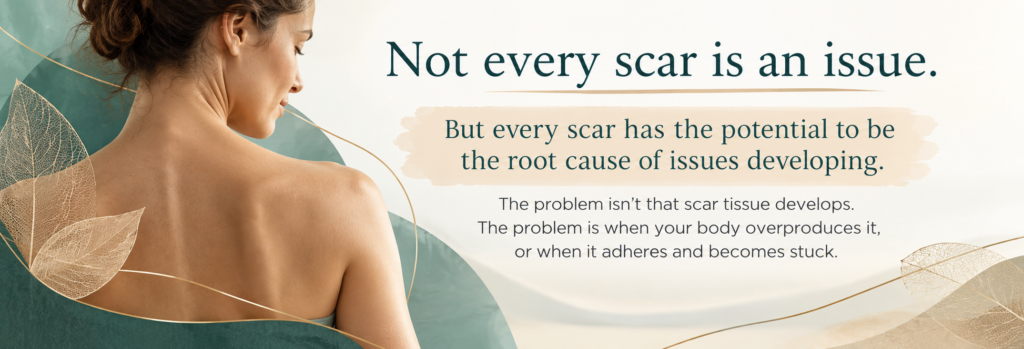
Not every scar is an issue.
But every scar has the potential to be the root cause of issues developing.
Scar tissue is your body’s natural repair process.
It forms after every surgery, injury, burn or trauma, and it is supposed to.
The problem isn’t that scar tissue develops.
The problem is when your body overproduces it, or when it adheres and becomes stuck.
That is what leads to restriction, and to your body compensating for it somewhere else.
And it is far easier to influence while the tissue is still forming than it is years later.
What adhered scar tissue does
When scar tissue adheres, it can bind together layers of skin, fascia, muscles, tendons, ligaments, nerves, and even internal organs.
As these tissues lose their ability to glide freely, movement becomes compromised.
The result may include:
- Pain or tenderness
- Tightness or pulling
- Reduced range of motion
- Weakness
- Numbness or tingling
- Altered posture or movement patterns
- Persistent swelling
- Difficulty returning to normal activities
Some of these appear immediately after surgery.
Others can develop years, or even decades, later.
What scar tissue can and cannot do
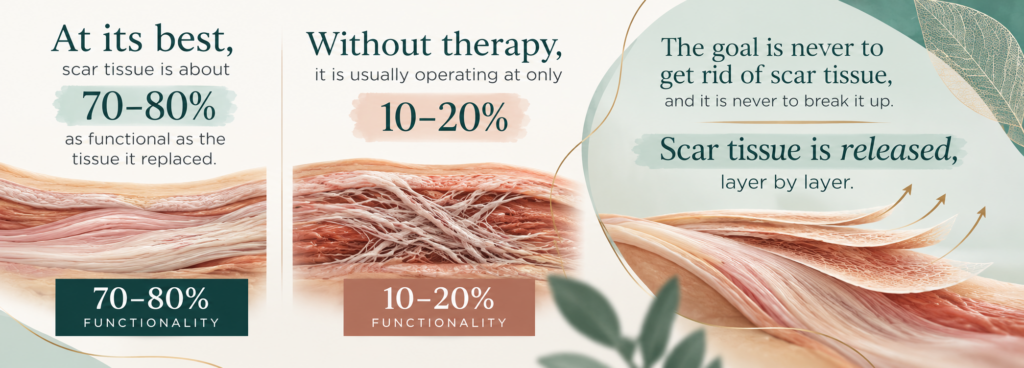
At its best, scar tissue is 70 to 80 percent as functional as the tissue it replaced.
Without therapy, it is usually operating at only 10 to 20 percent.
That gap is the reason any of this matters.
The goal is never to get rid of scar tissue, and it is never to break it up.
Scar tissue is released, layer by layer.
The goal is to get it working as close to that 70 or 80 percent as it can.
“But I was told to wait twelve weeks”
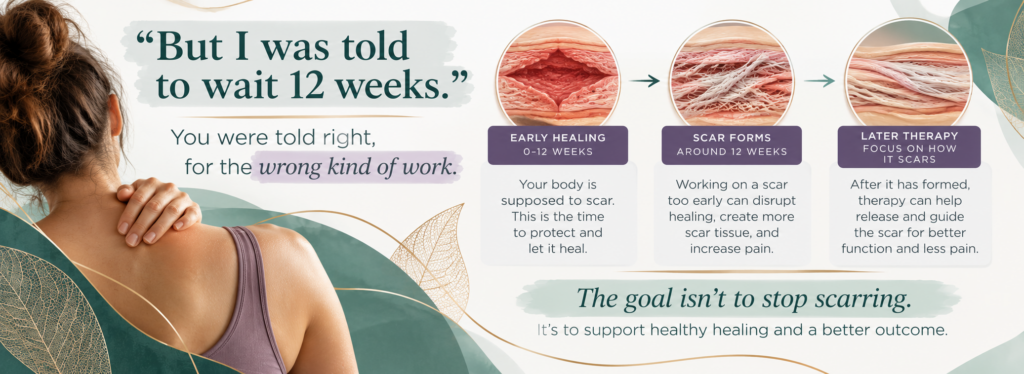
You were told right, for the wrong kind of work.
The standard advice is to wait ten to twelve weeks after surgery before anyone works on a scar, so the tissue has time to lay down.
That rule exists for a good reason.
You are supposed to scar.
Nobody should be in there working a scar before it has formed, or forcing a joint to bend before it is ready.
You cannot stop scarring without interrupting healing, and forcing it creates more scar tissue and more pain.
Unfortunately, a lot of therapies go after the scar, or the wound while it is still healing, far too soon.
They do the opposite of what they are trying to do.
How you scar is a different matter, and that can be guided.
What can be done in that window
There are two stages, and almost nobody explains the first one.
In the first three months, while the tissue is still laying down, you can start very light work almost immediately.
In a hospital bed, if that is where you are.
- Lymphatic work
- Gentle myofascial work
- Deep oscillation
- LymphaTouch
- Polarity therapy
- Gentle range of motion after a couple of weeks
It is half an hour, no more, and it is very light, with almost no manipulation.
The point at this stage is not to release anything.
The point is to guide the collagen and the tissue to heal in a better pattern, more congruent with the tissue around it.
Then at about three months, when the tissue is more set and the wound is considered mature, you can begin the release work.
Release means getting the tissue unstuck.
Scar tissue is never broken up, and it is never forced.
Adhesions are a different thing, and adhesions can be broken down.
What is happening there is a chemical change in the fluid between the tissue layers, altering the sticky back to free-flowing fluid.
Why earlier means less
Many people wait until pain becomes severe before seeking treatment, which is understandable.
By then the body has been working around the restriction for months or years, and the working-around has become a problem of its own.
A knee replacement can become hip pain, and then low back pain.
A shoulder repair can change how you turn your neck.
An abdominal incision can change how you breathe and how you hold your core.
Treat it early, and you are treating a scar.
Wait, and you are treating a scar plus years of compensation built on top of it.
Do the post-op work early, and you usually need very little of the heavier work later.
If your surgery hasn’t happened yet
That is the best phone call you can make.
If the surgery is planned and it isn’t an emergency, you should be having at least two lymphatic sessions in the seventy-two hours before it, and then again immediately after.
Your immune system is about to be attacked.
A surgery is a life-saving thing, and it is still an attack on the body.
You want that system cleared out and bolstered before it happens, not after.
Nobody ever mentions this, and it costs the medical side nothing to say it.
I can also prepare the side of your body that is about to take over the work while the other side is immobile.
Where I am
My office is in Wantagh, on the south shore of Long Island, in Nassau County.
No referral is needed to book.
Call 516-409-1240 and tell me what you have had done and what is going on. I will tell you honestly whether I can help, and whether it is too early.
“I’ve had a difficult time recovering from my ACL/Meniscus surgery. I’m approaching 6 months and still can’t fully extend my leg. After 2 sessions I already feel like my extension has improved. I’m hopeful I can avoid going back in for another procedure for them to scrape away the scar tissue now that I’m seeing Marjorie! She’s amazing!” – Jennifer Rosebuds
ABOUT THE AUTHOR
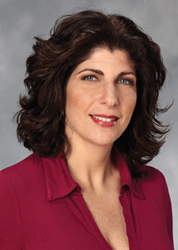
Marjorie Brook, LMT created the S.T.R.A.I.T Method™ for scar tissue release and has practiced it for 29 years in Wantagh, Long Island. She trains therapists internationally and has taught clinical staff at Singapore General Hospital and Shriners Children’s Hospital. About Marjorie → · Book an appointment →
Scar Tissue FAQs
When should you start scar massage after surgery?
The usual advice is ten to twelve weeks, and for hands-on release work that is right. The tissue needs time to lay down first.
Lighter post-operative work can begin much sooner, often within days. That is a different treatment: half an hour, very gentle, using lymphatic work, gentle myofascial work, deep oscillation, LymphaTouch and polarity therapy to guide how the tissue forms rather than to release it.
It depends on your procedure and how your incision is healing, so call and describe it.
When can you start C-section scar massage?
The same two stages apply. Light post-operative work can begin early; release work waits until the tissue has matured at around three months.
Call and describe the surgery, including whether it was planned or an emergency. Those are two different situations and they heal differently.
Can you prevent scar tissue after surgery?
No, and you would not want to. Scar tissue is how your body repairs itself, and you cannot stop it forming without interrupting healing.
What can be influenced is how it forms, and whether it adheres.
Can you break up scar tissue?
No. Scar tissue is released, layer by layer, and forcing through a restriction can cause the body to lay down more of it.
Adhesions are a different thing, and adhesions can be broken down. What is happening there is a chemical change in the fluid between the tissue layers, altering the sticky back to free-flowing fluid.
Does all scar tissue cause problems?
Not every scar is an issue. But every scar has the potential to be the root cause of issues developing.
At its best, scar tissue is 70 to 80 percent as functional as the tissue it replaced. Without therapy it is usually operating at only 10 to 20 percent.
Is it too late if my surgery was years ago?
Almost never. It does not matter how old a scar is. I have worked on scars as old as eighty years and made a difference.
Earlier is easier, because there is less compensation built on top of it. But old is not the same as closed.
Should I have anything done before surgery?
If the surgery is planned rather than an emergency, yes. At least two lymphatic sessions within seventy-two hours before, and again immediately after.
Your immune system is about to be under attack, and it is better to go in with it cleared out and bolstered.