
When Treatment Ends, Recovery Begins: The Missing Piece of Post-Operative and Oncology Care
By Marjorie Brook, LMT · Licensed massage therapist, 29 years · Creator of the S.T.R.A.I.T Method™
Published October 2026 · Wantagh, New York
When Treatment Ends, Recovery Begins: The Missing Piece of Post-Operative and Oncology Care
We Treat the Disease, But Who Treats the Person Left Behind?
Modern medicine has become extraordinarily successful at treating disease.
Surgeons remove tumors.
Oncologists attack cancer cells.
Radiation targets disease.
Medications control inflammation, infection, pain, hormones, and other complications.
Advanced treatments save lives that once could not have been saved.
These accomplishments are extraordinary.
But there is a question we need to ask more often:
What happens to the person after the treatment has done its job?
Because completing surgery, chemotherapy, radiation, immunotherapy, hormone therapy, or another medical treatment does not necessarily mean the person has recovered.
The disease may be gone.
The incision may be healed.
The scans may be clear.
The treatment may be considered successful.
And yet the person may still be struggling physically, mentally, emotionally, and functionally.
That is the gap in care we need to start talking about.
“Your Treatment is Over” Does Not Necessarily Mean “You Are Recovered”
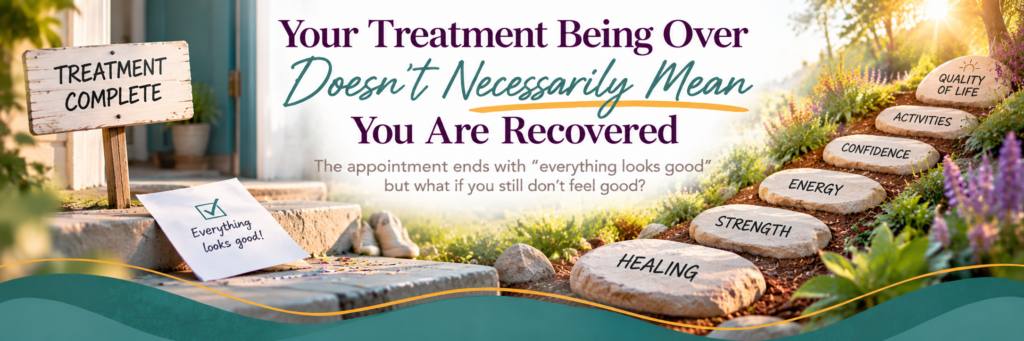
Patients are often given extensive instructions about what to do immediately after a procedure.
- Don’t lift.
- Don’t drive.
- Keep the incision clean.
- Take your medications.
- Watch for infection.
- Come back for your follow-up appointment.
Then eventually, the appointment ends with:
“Everything looks good.”
But what if the patient doesn’t feel good?
What if they still have:
- Pain or discomfort
- Tightness or pulling around a surgical site
- Restricted movement
- Changes in posture or movement
- Sensitivity or numbness
- Weakness
- Fatigue
- Swelling
- Changes in tissue mobility
- Sleep problems
- Digestive or bowel changes
- Changes in body image
- Anxiety or fear
- Difficulty concentrating
- Loss of physical confidence
- Difficulty returning to exercise or normal activities
These concerns are not imaginary.
They are recognized components of survivorship and post-treatment care.
The National Cancer Institute defines cancer survivorship broadly, encompassing the physical, mental, emotional, social, and financial effects of cancer from diagnosis through the rest of a person’s life.
Survival is an outcome. Recovery is a process. They are not the same thing.
The Medication Doesn’t Always Stop Affecting You When You Stop Taking It
There is another part of the conversation that is often overlooked: the after-effects of the medications and treatments themselves.
During treatment, patients are understandably focused on getting through it.
They may hear:
- “This medication may cause fatigue.”
- “You may experience nausea.”
- “You may have neuropathy.”
- “You may have changes in your hormones.”
- “You may experience cognitive changes.”
The immediate side effects are discussed because they are happening now.
But some treatment-related effects can persist long after the medication itself has been discontinued.
The American Cancer Society notes that some chemotherapy side effects can become long-term or chronic, lasting months or years, and in some circumstances can involve organs such as the heart, lungs, kidneys, or reproductive organs.
The National Cancer Institute likewise notes that some cancer-treatment effects may linger after treatment or first appear months or years later. These are referred to as late effects.
Depending on the treatment, patients may experience issues involving:
The nervous system
Some cancer treatments can contribute to peripheral neuropathy, altered sensation, weakness, balance problems, or other neurological symptoms.
The endocrine system
Certain treatments can affect thyroid function or reproductive hormones. Changes in hormone levels can influence energy, sleep, metabolism, mood, cognition, sexual function, bone health, and other aspects of health.
The cardiovascular system
Some chemotherapy drugs, targeted therapies, immunotherapies, and radiation treatments can have cardiovascular effects that may not become apparent immediately.
The respiratory system
Certain chemotherapy and radiation treatments can affect lung function, and symptoms can sometimes appear well after treatment.
The musculoskeletal system
Treatment can contribute to changes involving muscles, joints, bones, mobility, and connective tissue. Radiation, certain chemotherapy drugs, and steroids can contribute to joint changes and loss of motion.
Cognitive function
Some patients experience problems with memory, concentration, processing speed, or what is commonly referred to as “chemo brain.” Certain treatments can contribute to cognitive changes that persist beyond treatment.
Sleep and energy
Fatigue and sleep disturbances can persist long after active treatment. These aren’t necessarily solved by simply telling someone to “get more rest.” The American Cancer Society identifies fatigue and sleep problems as common long-term effects experienced by cancer survivors.
The important point is this:
The medication may leave the body, but the effects of the treatment may not immediately leave the person.
That distinction matters.
The Body Has Been Through Something
We sometimes talk about surgery as though it were simply an event:
Before surgery → surgery → after surgery.
But the human body doesn’t experience it that way.
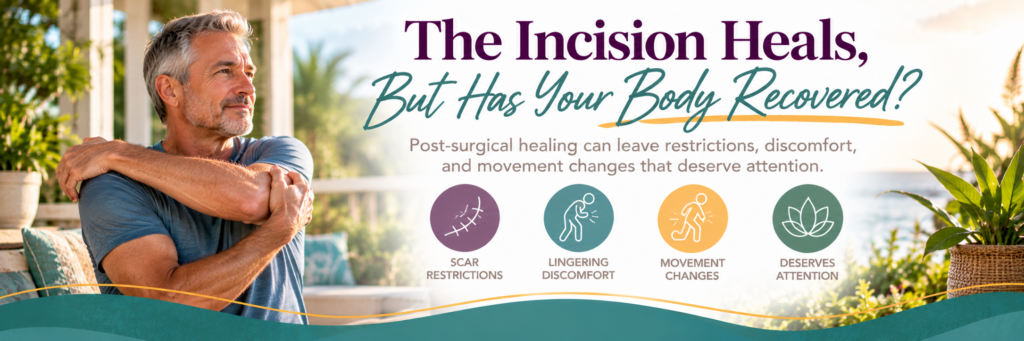
Surgery can involve cutting, separating, retracting, removing, repairing, repositioning, or otherwise altering multiple layers of tissue.
The body then has to heal.
That healing process can change the way tissues move and interact.
A scar isn’t simply a line on the skin.
For some people, the surrounding tissues may feel tight, restricted, sensitive, adhered, or uncomfortable. Movement patterns can change. The person may unconsciously protect an area, compensate somewhere else, or become hesitant to move normally.
And the effects aren’t always confined to the scar itself.
The body moves as a system.
This is one reason post-operative rehabilitation can be so important.
It is also why scar management should not be dismissed as purely cosmetic.
Oncology Recovery is More Than Cancer Surveillance
There is a tremendous amount of attention placed on monitoring whether cancer has returned.
Of course there should be.
But survivorship is about more than surveillance.
A person can be cancer-free and still be dealing with the consequences of having had cancer.
They may have finished treatment and still experience:
- Fatigue
- Neuropathy
- Hormonal changes
- Sleep problems
- Digestive problems
- Pain
- Restricted movement
- Changes in body image
- Cognitive changes
- Fear of recurrence
- Anxiety
- Depression
- Post-traumatic stress
- Loss of confidence in the body
The NCI specifically recognizes that cancer and its treatment can produce post-traumatic stress symptoms, including sleep problems, frightening thoughts, hyperarousal, isolation, and feelings of fear or helplessness. These symptoms can occur even years after initial treatment.
That means we cannot define successful recovery solely by whether the cancer is gone.
The patient has to be considered, too.
The Emotional Body Matters Too
There is another layer of recovery that cannot be measured by an MRI, CT scan, blood test, or surgical incision.
It is the emotional experience of living in a body that has been changed.

A person may look at a scar every day and remember the diagnosis.
They may be afraid every time they feel a new ache.
They may avoid touching an area that was operated on.
They may be afraid to exercise.
They may feel disconnected from their body.
They may feel angry that their body doesn’t work the way it used to.
They may feel guilty for struggling when everyone around them believes they should be celebrating.
They may hear:
“But you’re cancer-free!”
And think:
“I know. But I still don’t feel like myself.”
Those feelings deserve to be acknowledged.
They do not mean the person is ungrateful.
They do not mean treatment failed.
And they certainly do not mean the symptoms are “all in their head.”
They mean the person has been through something significant.
What a Scar Can Bring Back
I want to give you a real example of this, because it is the part people find hardest to believe until it happens to them.
I had a woman volunteer in one of my classes with a fifteen-year-old C-section scar.
It was barely visible on the surface, though there were adhesions underneath.
As I started working just above it, she said something I have never forgotten.
It felt, she said, like I was driving a railroad spike through her back.
I was working on her abdomen.
A few minutes later she mentioned something, almost in passing.
It had been an emergency C-section.
The epidural had gone wrong and left her temporarily paralyzed.
An epidural, and a railroad spike in the back. Fifteen years apart.
As we carried on, her mood changed completely.
She became angry, and upset, and frustrated.
And more of the story came out.
She had gone to her doctors two weeks earlier and told them the baby was too big.
Nobody listened to her.
Then the surgery went well, and the baby was born, and the paralysis passed.
And her focus went entirely to the baby rather than to herself.
She never actually dealt with having been temporarily paralyzed.
She came in the next day exhausted, having barely slept.
She had been thinking about how nobody had paid attention to her.
A few months later she emailed to say she was in the best state she had been in for a long time.
I am not a psychologist, and I do not pretend to be one.
What I can tell you is that a few scar tissue release moves over a fifteen-year-old scar brought all of that up.
And that she needed somewhere to put it.
If that happens to you in my office, you do not need to apologize for it.
It is one of the most normal things that happens here.
The Missing Middle of Healthcare
This is where I believe there is an enormous opportunity to improve patient care.
There is acute medical care. There is surgery. There is oncology treatment. There is rehabilitation. There is follow-up.
But between those pieces, there can be a tremendous gap.
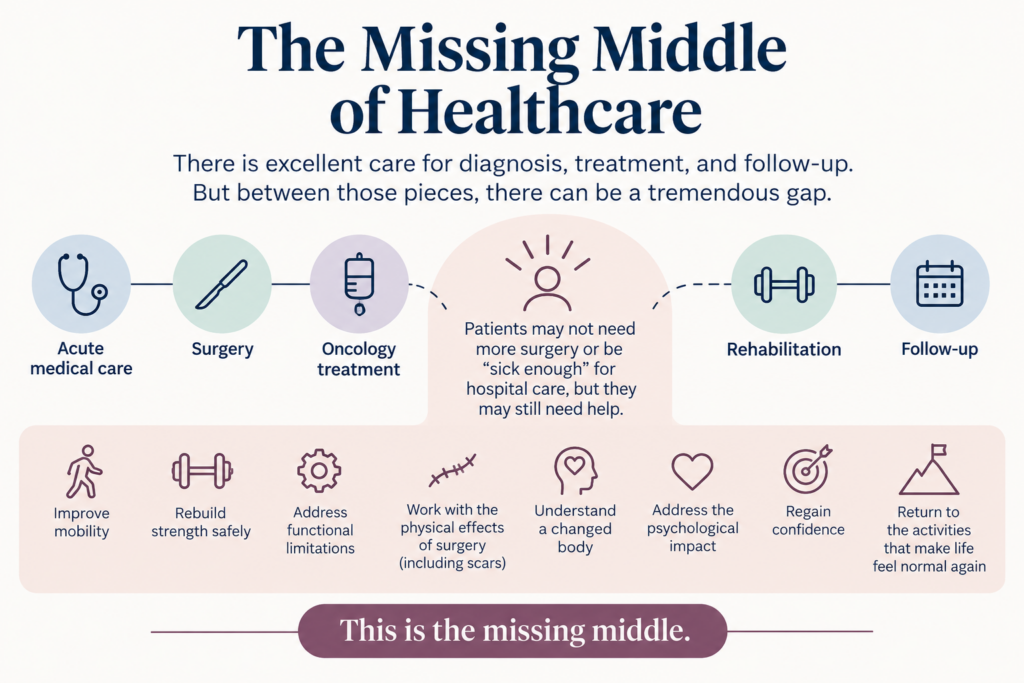
A patient may not need another surgery.
They may not need to be hospitalized.
They may not be “sick enough” for intensive medical intervention.
But they may still need help.
They may need someone to address mobility.
Someone to help them safely rebuild strength.
Someone to address functional limitations.
Someone to work with the physical consequences of surgery.
Someone to address scar-related restrictions.
Someone to help them understand their changed body.
Someone to address the psychological impact.
Someone to help them regain confidence.
Someone to help them return to the activities that make life feel normal again.
This is the missing middle.
Recovery Should be Multidisciplinary
No single practitioner should be expected to address everything.
That is not the answer.
The answer is better collaboration.
Depending on the person’s needs, a recovery team may include:
- The surgeon
- Oncologist
- Primary-care provider
- Physical therapist
- Occupational therapist
- Oncology rehabilitation specialist
- Lymphedema therapist
- Mental-health professional
- Nutrition professional
- Exercise professional
- Pain-management specialist
- Qualified massage or bodywork practitioner
- Scar-management specialist
- Other appropriate healthcare professionals
Each professional has a different role.
The goal isn’t to replace one another.
The goal is to stop leaving the patient to figure everything out alone.
The NCI recommends that survivors report physical concerns such as fatigue, bowel or bladder problems, sexual problems, concentration or memory changes, sleep problems, weight changes, and emotional concerns to their healthcare team so that appropriate causes and referrals can be considered.
That is what coordinated survivorship care should look like.
Where Scar Tissue Management Fits
This is where my work as a Licensed Massage Therapist and creator of the S.T.R.A.I.T. Method® – Scar Tissue Release And Integrated Therapies fits into the larger recovery picture.
I don’t believe scar tissue should be treated as an isolated cosmetic concern. I believe it needs to be considered in the context of the person.
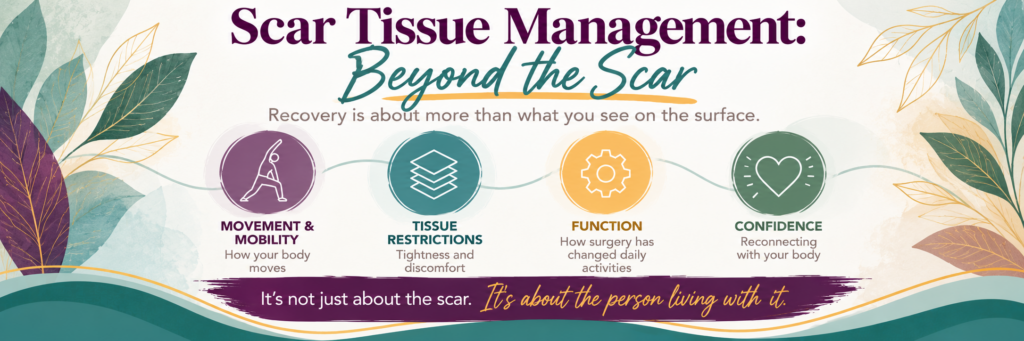
How is the individual moving?
What are they feeling?
What areas feel restricted?
How has the surgery changed their movement?
How has the person adapted?
What does the tissue feel like?
What does the person report?
What is medically appropriate?
And, perhaps most importantly:
What does this person need to regain function and confidence in their body?
The S.T.R.A.I.T. Method® is designed as an integrated approach to scar tissue release and related soft-tissue considerations.
It is not intended to repalce surgery, oncology care, physical therapy, medical evaluation, or mental-health treatment.
Instead, it can be one component of a comprehensive recovery plan when appropriate.
That distinction is important.
Good post-operative and oncology care should never be about one practitioner claiming to have all the answers.
It should be about putting the right professionals around the patient.
We Need to Stop Telling People to “Just Give It Time”
Time is important. Healing takes time. But time alone isn’t always treatment.
If a person has restricted movement six months after surgery, simply waiting another six months may not solve the problem.
If someone is experiencing persistent neuropathy, they need evaluation.
If hormone changes are affecting quality of life, those concerns deserve medical attention.
If someone is experiencing depression, anxiety, or trauma symptoms, they deserve appropriate psychological support.
If scar-related restrictions are affecting movement or comfort, appropriate evaluation and treatment may be worth exploring. And if symptoms are new, worsening, unusual, or unexplained, they should be discussed with the appropriate medical professional.
“Give it time” should not become “learn to live with it.”
Patients Need Permission to Ask for More
One of the most important messages I want patients to hear is this:
You are allowed to ask for help even when your treatment was successful.
You are allowed to say:
- “Something still doesn’t feel right.”
- “I don’t move the way I used to.”
- “I’m exhausted.”
- “I’m having trouble sleeping.”
- “My body feels different.”
- “I’m struggling emotionally.”
- “I’m afraid to exercise.”
- “I don’t recognize my body anymore.”
- “I want to feel like myself again.”
These are legitimate healthcare concerns.
And if your physician doesn’t have the answer, that doesn’t necessarily mean there isn’t an answer.
It may mean you need another member of the healthcare team.
The Goal Isn’t Just Survival
Survival matters. Of course it does. But what happens after survival matters, too.
The goal should be more than: “The cancer is gone.”
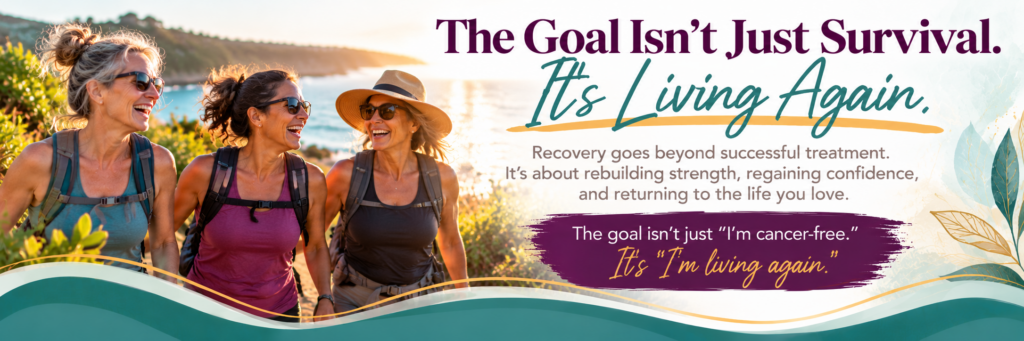
The goal should eventually become:
“I am living again.”
- I can move.
- I can exercise.
- I can sleep.
- I can work.
- I can participate in my relationships.
- I can touch my body without fear.
- I understand what has happened to me.
- I have support when I need it.
- I trust my body again.
- I feel like myself.
That is recovery.
A New Conversation About Post-Operative and Oncology Care
We need to stop thinking of recovery as the short period between leaving the hospital and returning to the surgeon.
Recovery can be much bigger than that.
It can be months. Sometimes years. And for some people, certain treatment effects can remain a lifelong consideration.
The medical community has increasingly recognized the importance of survivorship and late-effect care. The NCI notes that late effects may appear months or years after treatment and that early medical attention can help prevent or better manage some of them.
Now we need to make sure patients understand that this care exists. We need better communication between providers. We need better access to rehabilitation and supportive services. We need to recognize the effects of medications and treatments – not only while someone is taking them, but after treatment has ended.
And we need to stop separating the physical person from the emotional person.
They are the same person.
If You Finished Treatment But Don’t Feel Recovered, You’re Not Alone
If you have undergone surgery, cancer treatment, radiation, chemotherapy, immunotherapy, hormone therapy, or another significant medical procedure and you’re still experiencing physical or emotional difficulties, don’t automatically assume that you simply have to live with them.
Start with your medical team.
Ask questions.
Ask whether what you’re experiencing could be related to your treatment.
Ask what rehabilitation or supportive services might be appropriate.
And if necessary, ask for a referral.
Recovery is not an indulgence.
It is not a luxury.
It is not something you should have to apologize for wanting.
Your life after treatment matters.
And the person who survived the procedure deserves care just as much as the disease did.
My Approach to Recovery
As a Licensed Massage Therapist, educator, and creator of the S.T.R.A.I.T. Method®, my focus is on one piece of this larger recovery picture: helping appropriate patients address the physical consequences that may occur around scars and altered tissue following surgery or other procedures.
My work does not replace medical care.
It does not diagnose cancer recurrence, nerve injury, organ dysfunction, hormonal problems, or other medical conditions.
And it should never delay appropriate medical evaluation.
Instead, I believe qualified practitioners should work alongside the medical community to help patients address the aspects of recovery that may otherwise go unaddressed.
Because treating the disease is only part of the journey.
Helping the person recover is the next part.
If you are still struggling after surgery or cancer treatment, start a conversation with your healthcare team.
Ask what may be contributing to your symptoms.
Ask whether rehabilitation, oncology rehabilitation, physical therapy, mental-health support, or specialized scar/tissue care may be appropriate.
And most importantly: Don’t be afraid to advocate for yourself. You deserve to be heard. You deserve answers.
And you deserve the opportunity to recover – not just survive.
If you finished treatment and do not feel recovered, start with your medical team and ask what might be contributing. If part of what is going on is scar-related or how you are moving, call 516-409-1240 and tell me what you have had done. I will tell you honestly whether I can help. No referral is needed.
Frequently Asked Questions
My treatment was successful, so why do I still not feel right?
Survival is an outcome. Recovery is a process. They are not the same thing. The disease may be gone, the incision healed and the scans clear, and the person may still be struggling physically, mentally, emotionally and functionally. Those are recognised components of survivorship and post-treatment care.
Can treatment side effects continue after the treatment stops?
Some can. The American Cancer Society notes that some chemotherapy side effects can become long-term or chronic, lasting months or years. The National Cancer Institute likewise notes that some cancer-treatment effects may linger after treatment or first appear months or years later, which are referred to as late effects. Anything new, worsening, unusual or unexplained should be discussed with the appropriate medical professional.
Is it normal to feel emotional about a scar years later?
It is one of the most common things that happens in my office. People apologise for it and they should not.
Do you treat cancer or its side effects?
No. My work does not replace medical care, and it does not diagnose cancer recurrence, nerve injury, organ dysfunction, hormonal problems or other medical conditions. It should never delay appropriate medical evaluation. What I work with is the physical consequences that can occur around scars and altered tissue after surgery or other procedures, for appropriate patients, as one component of a recovery plan.
Who else should be on my recovery team?
Depending on what you need, that can include your surgeon, oncologist, primary-care provider, physical or occupational therapist, oncology rehabilitation specialist, lymphedema therapist, mental-health professional, nutrition and exercise professionals, and a pain-management specialist. No single practitioner should be expected to address everything. The goal is to stop leaving the patient to figure everything out alone.
————————————
ABOUT THE AUTHOR
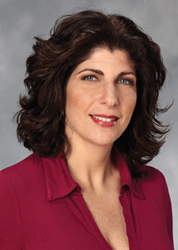
Marjorie Brook, LMT created the S.T.R.A.I.T Method™ for scar tissue release and has practiced it for 29 years in Wantagh, Long Island. She trains therapists internationally and has taught clinical staff at Singapore General Hospital and Shriners Children’s Hospital. About Marjorie → · Book an appointment →