
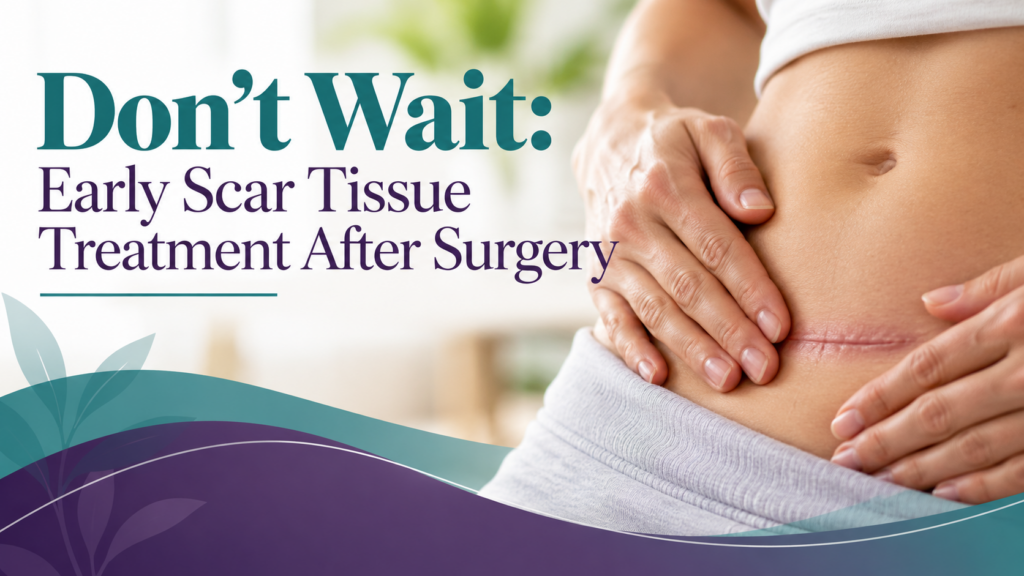
Don’t Wait: Early Scar Tissue Treatment After Surgery
When preparing for surgery, most people focus on the procedure itself. They ask about the surgeon’s experience, the risks, the recovery time, and when they can return to normal activities.
What many people don’t think about is what happens after the incision heals.
Unfortunately, once the stitches are removed and the scar looks “good,” patients are often told they’re finished healing.
Your incision has healed. The scar looks good. The surgeon is happy.
But you are not finished.
Underneath that scar, your body is still building. It will keep building for months – laying down collagen, layer by layer, deciding how everything in there is going to sit for the rest of your life. Nobody tells you this at the follow-up appointment, because the follow-up appointment is about the surgery. And the surgery went fine.
What happens next is up to the scar tissue. Or it’s up to you.
The part of healing nobody explains
Scar tissue is not a flaw. It’s the repair. Every surgery, every injury, every burn ends the same way – your body knits the wound shut with a mesh of collagen fibers, and that mesh is your scar.
The trouble isn’t the scar. The trouble is what forms around it.
To hold an injured area still while it heals, your body turns the ground substance between your tissues into something sticky, thick, and hard – scaffolding. When the healing is done, that scaffolding is supposed to clear.
It doesn’t always. And when it stays, it stays sticky.
Think about a Band-Aid. The pad in the middle sits over the wound. But the pad doesn’t stay there by itself – it needs the adhesive. And when the wound has healed, and you finally peel the Band-Aid off, does it come off clean? No. It leaves the residue behind. You can scrub, and it’s still there.
That residue is the adhesion. Every layer around it – skin, fascia, muscle, nerve, sometimes organ – is designed to glide. Now those layers move into the sticky spot and get stuck. And the sticking spreads in whatever direction you move.
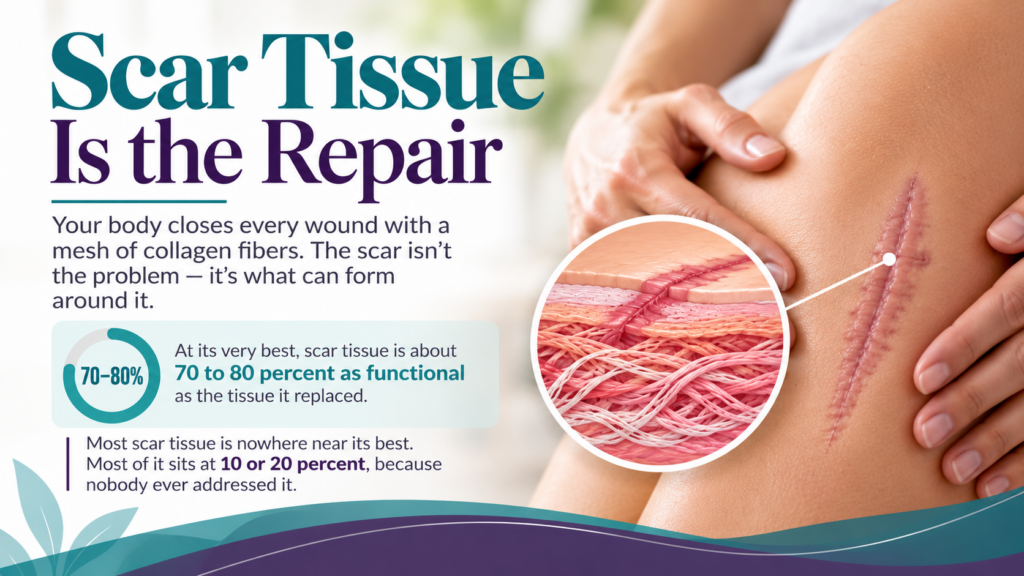
Here’s the number that should change how you think about your scar: at its very best, scar tissue is about 70 to 80 percent as functional as the tissue it replaced. Most scar tissue is nowhere near its best. Most of it sits at 10 or 20 percent, because nobody ever addressed it.
“But my scar looks fine”
Of course it does. Your surgeon closed the skin beautifully.
The skin is the last layer. Under it, there were six or seven layers of sutures – muscle, fascia, one layer after another. Anything can happen in those layers, and the surface will still heal perfectly.
I see this every week: a scar you’d barely notice, and a complete mess underneath.
Restricted scar tissue announces itself in ways that don’t seem connected to a scar:
- Pain or tenderness that never quite left
- A pulling sensation when you reach or twist
- Range of motion that came back — mostly
- Weakness on one side
- Numbness or tingling
- A posture or a walk that’s changed and you can’t say when
- Swelling that lingers
- Not being able to take a full, deep breath after abdominal or chest surgery
Sometimes these start right after surgery. Sometimes they take years.
What waiting actually costs
Most people wait until pain gets loud. I understand why. But by then, your body has spent months or years working around the restriction – and the working-around is now a problem of its own.
A knee replacement becomes hip pain, then low back pain. A shoulder repair changes how you turn your neck. An abdominal incision changes how you breathe, how you hold your core, how you digest.
Your body is one system. Restrict one part, and every other part picks up the slack. Nobody feels that happening. It just becomes how you move.
And there’s a reason early matters that almost no one explains. Say a wound heals in three phases and you’re in phase two. You reach for a can on the top shelf and tear one section of the scar. That section goes back to phase one. A few weeks later, part of the scar is in phase three, part is in phase two – and you tear another section. Now you have all three phases in one scar. It doesn’t heal evenly; the adhesions spread with every movement, and that unevenness is where the long-term problems start.
Treat it early, and you’re treating a scar. Wait, and you’re treating a scar plus years of compensation built on top of it. It’s easier to prevent a problem than to undo one.
“I was told to wait twelve weeks”
You were told right – for the wrong kind of work.
The standard advice is to wait ten to twelve weeks after surgery before anyone works on a scar, so the tissue has time to lay down. That rule exists for a reason. You are supposed to scar. Nobody should be in there trying to “break it up” before it forms, or forcing a joint to bend that isn’t ready. You can’t stop scarring without interrupting healing, and forcing it creates more scar tissue and more pain.
How you scar is a different matter. That can be guided.
So people come to me right after surgery – not for the full hands-on release, but for a post-op session that’s built for that window. Half an hour, no more. Very light, very gentle, almost no manipulation. Deep oscillation, LymphaTouch, polarity therapy, gentle myofascial work – so the tissue lays down in the order and direction it’s supposed to. Guide the scar while it’s forming, and you usually need very little of the heavier work later.
If your surgery is still ahead of you, even better. Come in for lymphatic work in the seventy-two hours before, so your system is cleared and boosted before it gets hit. Eat clean. Get your vitamins up. Some people heal beautifully no matter what, and some heal poorly no matter what – genetics is real – but preparation gives your body its best chance.
“I was told I’d have to live with it”
I hear that sentence from most of the people who walk through my door.
The surgeon’s job was to fix what was broken, and the surgeon did that. The physical therapist’s job was to get the joint moving, and it moves – mostly. Nobody’s job was the scar tissue. So when you’re still pulling, still stiff, still not right, the honest answer from everyone involved is: you’re just going to have to live with it.
They’re not lying. They’ve reached the edge of what they do.
I work past that edge. That’s the whole practice.
A man flew in from Minnesota after more than a year of every pain doctor telling him to suffer with it. A week of intensive work later, he was most of the way out of pain and getting on a plane home. A woman recovering from brain surgery after a stroke, with a scar across the back of her skull, told her surgeon over and over how much the restriction hurt. He said, “Sorry.” After one session, she could turn her head, and she booked again for four days later.
I can’t promise you an outcome, and I won’t. What I can tell you is that “live with it” is a conclusion far more often than it’s a diagnosis.
(If your scar is years old and you want to understand why it still hurts — and why the pain often isn’t where the scar is — I’ve written about that separately. This post is about the other half of the question: when to act.)
Still pulling, stiff, or not moving right after surgery? Book a scar tissue assessment →
“It’s too late for me”
It isn’t. I’ve worked on scars as old as eighty years and made a difference.
Your fascia is malleable. It doesn’t stop being malleable because a decade went by. I see C-section scars ten, fifteen, twenty years later and still change things – women who are no longer in pain, who can ride a bicycle again, who get their lives back.
One client in her seventies came to me after abdominal surgery and breast implant removal, with hard lumps in the tissue and a stomach she described as a twisted mess. Her stomach is smooth now, her belly button is back, and the last thing she told me was that she’s going to go buy a two-piece bathing suit.
So no – it’s not too late. It’s just that earlier is easier, and later means undoing more.
What I Actually Do
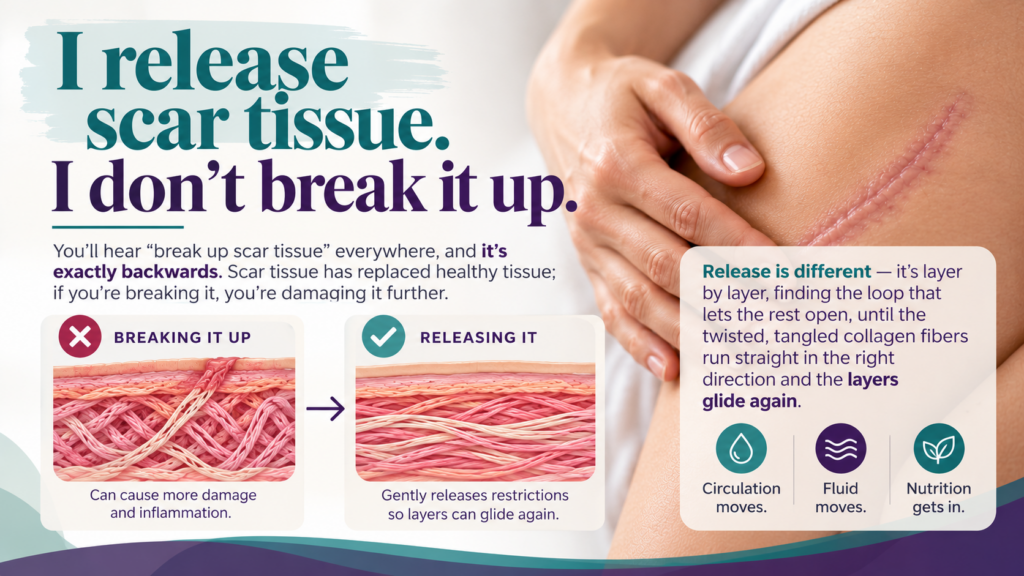
I release scar tissue. I don’t break it up.
You’ll hear “break up scar tissue” everywhere, and it’s exactly backwards. Scar tissue has replaced healthy tissue; if you’re breaking it, you’re damaging it further. Release is different – it’s layer by layer, finding the loop that lets the rest open, until the twisted, tangled collagen fibers run straight in the right direction and the layers glide again. Circulation moves. Fluid moves. Nutrition gets in.
And because your body has been compensating around the restriction, the work doesn’t end at the scar. Once it’s released, I reset the way you move — so your body relearns how to function instead of staying in the workaround it built. My joke is that I try to bring you back to factory settings as much as possible.
The approach is called the S.T.R.A.I.T Method™ — Scar Tissue Release and Integrated Therapies. I developed it, and for 29 years it’s been the whole of my practice. I teach it to therapists in more than a dozen countries; Singapore General Hospital and Shriners Children’s Hospital flew me in to train their staff. Every session in my Wantagh office is still me, one person, start to finish.
What I won’t do
I won’t tell you how many sessions you need before I’ve seen you. I can’t know that from a phone call, and anyone who gives you a number before an assessment is selling you something.
Two people can have the same surgery and heal on completely different timelines. Metabolism, daily activity, how soon you go back to work, what else is going on in the body. So the first visit is an assessment – how you move, where you’re restricted, what the scar tissue is actually doing – and then we decide together.
About 80 percent of the people who come in for a first session book a second one. That’s not a guarantee. It’s the closest thing to one I’m willing to give you: most people who feel this work decide it’s worth continuing.
Don’t wait for it to become normal
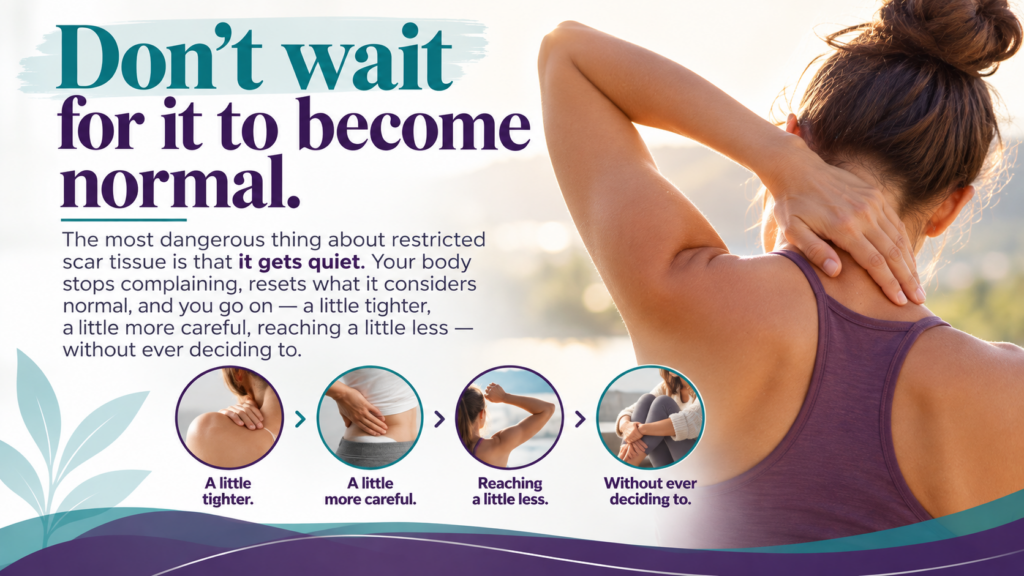
The most dangerous thing about restricted scar tissue is that it gets quiet. Your body stops complaining, resets what it considers normal, and you go on – a little tighter, a little more careful, reaching a little less – without ever deciding to.
A successful surgery isn’t measured by how the incision looks. It’s measured by how you move. How you sleep. Whether you can pick up your kid without bracing first, or go a whole day without thinking about the scar.
If you notice pain, pulling, stiffness, weakness, or a limit that didn’t used to be there — don’t wait for it to get loud. And if it’s been years, don’t assume the window closed.
Come in once. See how you feel. Decide from there.
“I’ve had a difficult time recovering from my ACL/Meniscus surgery. I’m approaching 6 months and still can’t fully extend my leg. After 2 sessions I already feel like my extension has improved. I’m hopeful I can avoid going back in for another procedure for them to scrape away the scar tissue now that I’m seeing Marjorie! She’s amazing!” – Jennifer Rosebuds
ABOUT THE AUTHOR

Marjorie Brook, LMT created the S.T.R.A.I.T Method™ for scar tissue release and has practiced it for 29 years in Wantagh, Long Island. She trains therapists internationally and has taught clinical staff at Singapore General Hospital and Shriners Children’s Hospital. About Marjorie → · Book an appointment →
Scar Tissue FAQs
When is it too late to massage scar tissue?
Never. I’ve worked on scars as old as eighty years and made a difference — your fascia is malleable. Earlier is easier because you’re treating the scar alone, not years of compensation built on top of it.
How soon after surgery can scar tissue be treated?
With me, right away. The usual advice is to wait ten to twelve weeks, and that’s right for full hands-on release — but I have a gentle half-hour post-op protocol that guides the scar as it forms. Call, describe your surgery, and I’ll tell you honestly where you are.
How long does scar tissue take to form after surgery?
The skin closes in a couple of weeks. The layers underneath keep laying down and remodeling collagen for months, and the adhesions around them keep spreading as long as you keep moving into them. That window – while the tissue is still deciding how to lay down — is when guiding it is easiest.
How do you break up scar tissue after surgery?
You don’t. Scar tissue has replaced healthy tissue; forcing it damages it further and creates more. I release it, layer by layer, so the collagen fibers run straight and the layers glide again.
Can scar tissue cause pain?
Yes. Restricted scar tissue and the adhesions around it bind skin, fascia, muscle, nerves, and sometimes organs together, so tissues that should glide can’t. That shows up as pain, pulling, tightness, numbness, weakness, or swelling — at the scar, or somewhere the body is compensating for it.
What’s the hard lump under my incision?
Almost everyone has one at one end of a scar. It’s usually the knot from the sutures, which don’t fully dissolve. It can also be scar tissue, an adhesion, or – depending on the surgery – mesh. Occasionally the body encapsulates sutures and the tissue inside never fully heals; that has to be released so the body can finish the job.
My knee is still tight a year after replacement and physical therapy didn’t help. What else can I do?
Unless it’s a mechanical problem with the implant, it’s the scar tissue. It needs to be released – and then the whole body has to relearn how to walk, stand, and take stairs, because your gait changed before the surgery from the pain, during rehab from favoring the knee, and the other leg has been doing all the work the whole time.
Does it matter what kind of surgery I had?
No. Joint replacements, C-sections, mastectomies, spinal, abdominal, heart, and cosmetic surgeries all create scar tissue, and even small laparoscopic incisions can restrict tissue well beyond the visible scar.