
Mobility vs. Flexibility
By Marjorie Brook, LMT · Licensed massage therapist, 29 years · Creator of the S.T.R.A.I.T Method™
Published October 2026 · Wantagh, New York
Mobility vs. Flexibility: Why You Can’t Strengthen Your Way Out of a Restriction
These two words get used as though they mean the same thing. They don’t.
Flexibility generally refers to the ability of tissues and joints to move through a range of motion.
Mobility is broader.
It incorporates the ability to actively access, control, and use available movement.
A person may be able to achieve a position passively but lack the strength or motor control to actively move there.
That person may have flexibility without functional mobility.
Which matters, because the difference decides what will actually help you.
Flx + Str = B
Flexibility + Strength = Balance
Maintained Balance = Stability
We have become obsessed with strength.
If something hurts, we strengthen it.
If something is weak, we strengthen it.
If someone has an injury, we strengthen it.
If someone wants to improve their body, we strengthen it.
If someone wants to age well, we tell them to strength train.
And yes – strength matters.
But there is a problem with the strength-first philosophy:
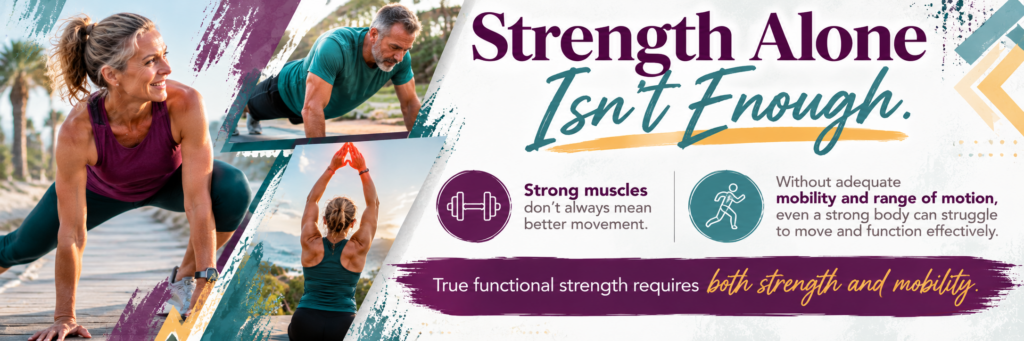
A strong muscle that cannot move effectively through the range of motion required for a task is not necessarily a functional muscle.
Strength without adequate mobility can create a very strong body that still does not move particularly well.
And when rehabilitating an injury – or simply trying to improve how the body functions – we need to ask a question that is often overlooked:
Can the body move before we ask it to produce more force?
That is where flexibility comes in.
Strength is Important. But It Is Not the Whole Equation
I am not suggesting that strengthening is unnecessary.
Far from it. Strength is essential for function. We need strength to walk, climb stairs, lift, push, pull, stabilize joints, maintain posture, perform daily activities, and participate in exercise and sport.
Resistance training is an important part of physical fitness and rehabilitation.
But strength is only one component of movement.
Consider what happens when you strengthen a muscle that is already restricted.
You may make it stronger.
But you have not necessarily changed the restriction.
You may have increased its ability to generate force within the range it already has.
That is very different from improving the body’s ability to move freely through the range of motion it needs.
This is why I believe the conversation needs to shift from:
“How strong is it?”
to:
“Can it move?”
And then:
“Can it control that movement?”
And finally:
“Can it produce and control force throughout that movement?”
That is a very different approach
My Formula: Flx + Str = B
I use a simple concept to explain this:
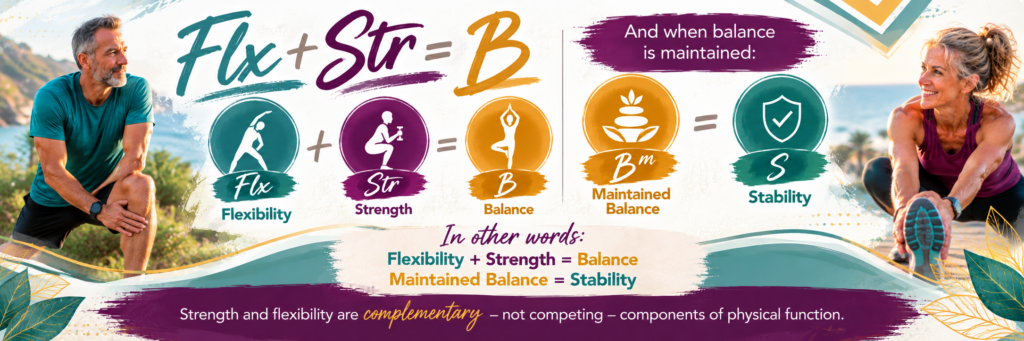
Flx + Str = B
Flx = Flexibility
Str = Strength
B = Balance
And when balance is maintained:
Bᵐ = S
S = Stability
In other words:
Flexibility + Strength = Balance
Maintained Balance = Stability
This is not meant to be a mathematical equation in the traditional scientific sense.
It is a way of illustrating a fundamental concept:
Strength and flexibility are complementary – not competing – components of physical function.
One without the other creates an incomplete equation.
Why Flexibility Should Come First
Imagine trying to strengthen a joint that cannot move through its intended range.
You can certainly train it.
But what are you actually training?
You may be strengthening the muscles to work around the limitation.
You may be teaching the body to compensate. You may be increasing force production without addressing why movement is restricted in the first place. Sometimes that is exactly what is needed. But sometimes it isn’t.
Before asking the body to produce more force, we should ask whether the tissues and joints involved have enough mobility to perform the movement efficiently.
Mobility creates the opportunity for movement.
Strength creates the ability to control and produce force during that movement.
Those are different things.
Stretching is Not the Same as “Loosening Up”
Stretching is sometimes treated as an optional five-minute activity at the end of a workout.
Something you do if you have time.
Something you skip when you’re busy.
Something that belongs in yoga class but not necessarily in serious rehabilitation or strength training.
That perception is outdated.
The way that we have learned to stretch all our lives loads the muscle, overtaxes the muscle and stresses the muscle. The end result is not really a stretch. It is a fight.
Stretching is something we do naturally.
The question you should really be asking is how we should consciously stretch.
What I teach is designed to work with the body, not against it.
The American College of Sports Medicine recognizes flexibility as an important component of physical fitness and describes stretching as a means of maintaining or improving range of motion. Research also consistently demonstrates that stretching can increase range of motion. A 2023 systematic review and meta-analysis examined 77 studies and 186 effect sizes and confirmed that chronic stretch training can produce sustained improvements in range of motion.
That matters.
Because range of motion isn’t simply about being able to touch your toes.
It affects how we move.
How we reach.
How we squat.
How we walk.
How we rotate.
How we lift.
How we change position.
How we perform everyday activities.
Flexibility is functional.
But Can’t Strength Training Improve Flexibility
Yes.
And this is where the conversation becomes interesting.
Research has shown that resistance training performed through an appropriate range of motion can improve range of motion as well. One systematic review and meta-analysis found no significant difference between resistance training and stretching in their effects on range of motion.
Another systematic review concluded that resistance training can improve range of motion to a moderate degree.
So does that mean stretching is unnecessary?
No.
It means the human body is adaptable and that there is more than one way to influence mobility. It does not mean that every strength program adequately addresses every individual’s flexibility restrictions. It does not mean that a person with a specific mobility limitation will automatically regain the movement they need simply by lifting weights. And it certainly does not mean that stretching has no place in rehabilitation.
In fact, the evidence supporting stretching’s ability to improve range of motion is substantial.
The better question is not:
Stretching OR strengthening?
It is:
Where does each belong in the sequence?
You Cannot Strengthen Your Way Out of Every Restriction
This is particularly important following injury, surgery, immobilization, or periods of inactivity.
When the body has been injured, it often develops protective patterns.
Muscles may become guarded.
Movement may become limited.
Tissues may become less extensible.
Joints may lose range.
A person may unconsciously avoid certain movements because they hurt or feel threatening.
Then rehabilitation begins.
The person is told: “We need to get you stronger.” And they begin strengthening. But what if the primary problem isn’t simply weakness?
What if the person can’t access the movement required to perform the exercise correctly?
What if the surrounding tissues are restricting the movement?
What if the person is compensating?
What if the body has learned a different movement pattern?
What if the person has enough strength – but insufficient mobility to use that strength effectively?
In those situations, more strength isn’t necessarily the first answer.
The Body Needs Room to Move
Think of movement as having three fundamental questions:
- Can I get there?
That’s mobility and flexibility.
- Can I control myself there?
That’s strength and motor control.
- Can I maintain that control under changing demands?

That’s where balance, coordination, and stability become increasingly important.
If you skip the first step, the rest of the equation can become compromised.
A person may have tremendous strength but still struggle to reach overhead.
A person may have powerful legs but poor ankle mobility.
A person may have strong abdominal muscles but difficulty moving through the spine and pelvis.
A person may have strong shoulders but limited thoracic or shoulder mobility.
A person may be able to lift heavy weights but have difficulty getting down onto the floor and back up.
Strength does not automatically equal movement quality.
Flexibility is Not the Enemy of Strength
There has also been a long-standing fear that stretching somehow makes people weak.
This concern has some scientific basis in specific circumstances: prolonged static stretching immediately before explosive activity can temporarily affect force or power in some situations. The effects depend on the type, duration, and intensity of stretching.
But that is very different from saying:
“Stretching makes you weak.”
It doesn’t.
Long-term flexibility training can improve range of motion, and the broader evidence does not support treating flexibility and strength as mutually exclusive qualities.
The question is how, when, and why stretching is applied.
That is where individualized programming matters.
The Problem with One-Size-Fits-All Rehabilitation
There is no single exercise that is appropriate for every body.
There is no single stretching technique that is appropriate for every person.
There is no single strengthening protocol that is appropriate for every injury.
And there is no universal sequence that applies to every rehabilitation situation.
A post-operative patient is not the same as a healthy athlete. Someone with chronic restrictions is not the same as someone who is simply deconditioned. Someone recovering from an orthopedic injury is not the same as someone with neurological limitations. Someone with scar-related restrictions is not the same as someone whose primary problem is muscular weakness.
The body needs assessment before prescription.
Stretching Can Change the Starting Point
Imagine a joint that has 90 degrees of functional movement available when the task requires 120 degrees.
You can strengthen the muscles surrounding that joint.
But if the joint still cannot access the movement required, the person may continue to compensate.
Now imagine improving the available range of motion.
Suddenly, there is a larger movement window within which the muscles can operate.
Now strengthening can occur through a more useful range.
That is the principle behind my argument:
Don’t just strengthen the restriction. Address the restriction. Then strengthen the newly available movement.
Strength Should Follow Function
The ultimate goal isn’t to become flexible. And it isn’t to become strong. The goal is function. We want the person to be able to use their body.
That means we need:
- Mobility
- Strength
- Control
- Coordination
- Balance
- Stability
These qualities work together.

This is why I prefer to think in terms of:
Flx + Str = B
Flexibility plus strength creates the conditions for better balance.
And when that balance can be consistently maintained and controlled:
Bᵐ = S
Balance maintained becomes stability.
Again, this isn’t a claim that one formula explains all human biomechanics.
It is a framework for understanding that stability is not simply strength.
A joint can be surrounded by extremely strong muscles and still lack the mobility, coordination, proprioception, or motor control necessary for optimal function.
Stability is Not the Same as Rigidity
This is another important distinction.
Some people confuse stability with being stiff.
They aren’t the same.
Rigidity limits movement. Stability controls movement.
A healthy body needs both mobility and control.
Think about your shoulder. It needs an enormous amount of mobility. But it also needs to be stable.
Your hip needs to move freely while remaining controlled.
Your spine needs mobility while being able to support and transfer forces.
Your ankle needs enough mobility to allow efficient walking, squatting, and changing direction.
The body is constantly balancing freedom of movement with control. That’s why flexibility and strength aren’t enemies. They are partners.
Rehabilitation Should Restore Movement – Not Just Build Muscle
This is where I believe rehabilitation professionals and fitness professionals need to broaden the conversation.
When someone comes into rehabilitation after an injury, the goal shouldn’t simply be:
“How much strength can we build?”
The questions should include:
- What movement has been lost?
- Why has it been lost?
- What tissues are restricting it?
- Is pain limiting movement?
- Is fear limiting movement?
- Is weakness limiting movement?
- Is the nervous system limiting movement?
- Is the joint itself restricted?
- Has the person developed compensatory movement patterns?
- What range of motion does the individual actually need?
- Can they control that range?
- Can they produce force through that range?
- Can they maintain balance while doing it?
Only then can we develop a truly functional rehabilitation strategy.
Stretching Should Not Be An Afterthought
For decades, stretching has often been relegated to the last five minutes of a workout.
“Stretch when you’re done.”
But flexibility deserves more thoughtful consideration than that.
Especially when someone is beginning rehabilitation.
Especially when someone has experienced immobilization.
Especially when movement is restricted.
Especially when there are significant differences between sides.
Especially when someone cannot perform an exercise correctly because they cannot physically access the necessary position.
And especially when the goal is not simply to become stronger – but to move better.
The Goal is Not Maximum Flexibility
There is an equally important caution here. More flexibility isn’t automatically better. A person doesn’t need to be able to put their leg behind their head to have a healthy body. Excessive mobility without sufficient control can create its own problems.
This brings us back to the equation.
Flx + Str = B
We don’t want flexibility without strength.
We don’t want strength without mobility.
We want the appropriate amount of each for the person, the activity, and the goal.
The objective isn’t maximum flexibility. It is functional flexibility.
The amount of mobility necessary to perform a movement effectively and safely.
Where Integrated Therapeutic Stretching™ (I.T.S) Fits

This philosophy is one of the reasons I developed Integrated Therapeutic Stretching™ (ITS).
The premise is not simply:
“Let’s stretch because stretching is good.”
It is: Let’s identify what isn’t moving, understand how that restriction affects function, and work toward improving the available movement so that the body can use it.
Stretching becomes purposeful rather than generic.
It becomes part of a larger movement strategy. And once appropriate range of motion is available, strengthening can be used to help the individual control and utilize that range. That is a very different approach from simply stretching everyone the same way – or strengthening everyone the same way.
Stretch First. Strengthen Second. Integrate Both.
I’m not advocating abandoning strength training.
Quite the opposite. I want strength training to be more effective.
If the body has appropriate mobility, the person may be able to perform strengthening exercises with better mechanics and through a more functional range.
If movement is restricted, address the restriction.
If strength is lacking, build strength.
If balance is impaired, train balance.
If stability is compromised, develop control.
If the nervous system is contributing to the problem, address that appropriately.
The answer isn’t always stretching. The answer isn’t always strengthening. The answer is understanding what the body needs first.
The Bigger Picture
Perhaps the real problem isn’t that physical therapists or personal trainers don’t value stretching.
Many absolutely do. The problem is that our culture has become strength-obsessed. We celebrate how much someone can lift. How many repetitions they can perform. How much muscle they can build. How heavy the resistance is.
But we don’t always celebrate how well someone moves.
- Can they rotate?
- Can they reach?
- Can they squat?
- Can they bend?
- Can they extend?
- Can they balance?
- Can they control their body?
- Can they move without compensation?
- Can they use their strength through an appropriate range?
Those are equally important measures of physical capability.
The Equation We Should Remember
So the next time someone tells you:
“You need to get stronger.”
Ask:
“Do I also have the mobility to use that strength?”
Because strength without movement is limited.
Mobility without strength is incomplete.
But when we combine the two:
Flx + Str = B
Flexibility + Strength = Balance
And when that balance can be maintained and controlled:
Bᵐ = S
Maintained Balance = Stability
That is the foundation of functional movement.
Not strength alone.
Not flexibility alone.
Integration.
Move First. Then Make the Movement Strong
The body doesn’t exist as isolated muscles. It exists as an interconnected system. And rehabilitation shouldn’t be about making one muscle stronger simply because it tested weak. It should be about understanding why the person isn’t moving well and addressing the factors contributing to that limitation.
Sometimes the answer is strength.
Sometimes it is mobility.
Sometimes it is both.
Sometimes it is coordination.
Sometimes it is balance.
Sometimes it is the nervous system.
And sometimes it is the tissue restriction that nobody has addressed.
Before you ask the body to produce more force, make sure you have given it the movement necessary to use that force. Because the ultimate goal isn’t simply a stronger body. It’s a body that can move, control, adapt, and function.
Flexibility gives movement somewhere to go.
Strength gives movement power and control.
Balance brings the two together.
And stability allows us to maintain that control when life demands change.
If you have been strengthening something for months and it still does not move the way it should, call 516-409-1240 and tell me what is going on. No referral is needed.
Mobility, Flexibility & Strengthening Frequently Asked Questions (FAQs)
What is the difference between mobility and flexibility?
Flexibility is the ability of tissues and joints to move through a range of motion. Mobility is broader – it includes whether you can actively access that range, control yourself in it, and use it. Someone can be moved into a position passively and still lack the strength or motor control to get there themselves. That is flexibility without functional mobility.
Should I stretch or strengthen first?
It depends which one is limiting you, which is why assessment comes before either. Stretching comes first when mobility is the limiting factor. If you already have adequate mobility, strengthening may appropriately come first.
Can you just strengthen your way out of tightness?
Sometimes, and sometimes not. Strengthening a restricted muscle can increase its ability to generate force within the range it already has, without changing the restriction – and it can teach the body to compensate around the limitation instead.
Does stretching make you weaker?
Prolonged static stretching immediately before explosive activity can temporarily affect force or power in some situations, depending on type, duration and intensity. That is very different from stretching making you weak over time. The broader evidence does not support treating flexibility and strength as mutually exclusive.
Is more flexibility always better?
No. Excessive mobility without sufficient control can create its own problems. The objective is functional flexibility – enough mobility to perform a movement effectively and safely – not maximum flexibility.
Why does this matter after surgery or an injury?
Because an injured body develops protective patterns. Muscles guard, movement narrows, tissues become less extensible and joints lose range. If rehabilitation starts from “we need to get you stronger” without asking why the movement is not there, the strengthening can be built on top of the restriction.
————————————
ABOUT THE AUTHOR

Marjorie Brook, LMT created the S.T.R.A.I.T Method™ for scar tissue release and has practiced it for 29 years in Wantagh, Long Island. She trains therapists internationally and has taught clinical staff at Singapore General Hospital and Shriners Children’s Hospital. About Marjorie → · Book an appointment →
References & Further Reading
- American College of Sports Medicine (ACSM). ACSM’s Complete Guide to Fitness & Health. ACSM. Discusses flexibility as the ability to move joints through their available range of motion and the role of stretching in maintaining or improving flexibility.
- American College of Sports Medicine. ACSM Resources for the Exercise Physiologist. Discusses flexibility exercise, stretching methods, range of motion, and the physiological effects of stretching.
- Afonso, J., et al. Strength Training versus Stretching for Improving Range of Motion: A Systematic Review and Meta-Analysis. Healthcare, 2021. Eleven randomized controlled trials involving 452 participants found no significant difference between strength training and stretching for improvements in range of motion, highlighting that both approaches can influence mobility.
- Konrad, A., et al. Chronic Effects of Stretching on Range of Motion with Consideration of Potential Moderating Variables: A Systematic Review with Meta-Analysis. Sports Medicine, 2023. The review examined 77 studies and 186 effect sizes and found meaningful improvements in range of motion following chronic stretching interventions.
- Behm, D. G., et al. Acute Effects of Various Stretching Techniques on Range of Motion: A Systematic Review with Meta-Analysis. Sports Medicine – Open, 2023. Review of 47 studies examining the acute effects of different stretching methods on range of motion.
- Cook, M. D., et al. The Effects of Static Stretching Intensity on Range of Motion and Strength: A Systematic Review. Journal of Functional Morphology and Kinesiology, 2023. The review found that static stretching increased range of motion across the included studies while also highlighting the importance of stretch intensity and its potential effects on strength.
- Lohmann, L. H., et al. Acute and Chronic Effects of Stretching on Balance: A Systematic Review with Multilevel Meta-Analysis. Frontiers in Medicine, 2024. The review examined the potential relationship between stretching and balance and emphasized that balance is multifactorial, involving strength, flexibility, proprioception, and other factors. The authors caution that the current evidence for stretching’s direct effect on balance remains limited and of low certainty.
- Guo, W., et al. A Systematic Review and Meta-Analysis of the Impact of Stretching Techniques on Balance Performance. Somatosensory & Motor Research, 2025. The review examined static and dynamic stretching and balance outcomes, highlighting the importance of stretching type, duration, and timing.